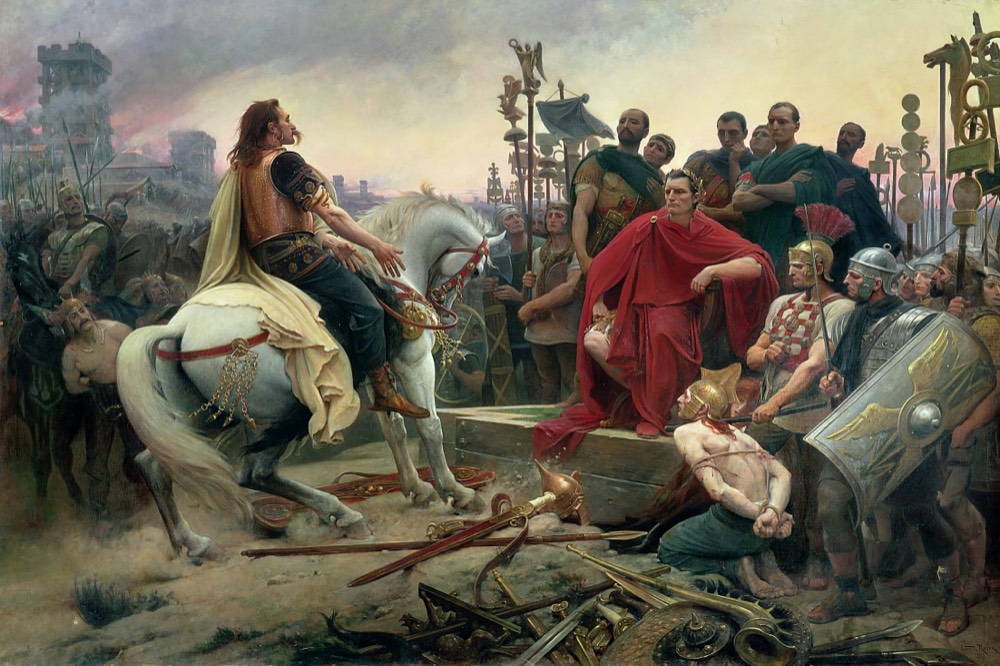
What happened
In the autumn of 52 BC, Caesar trapped the Gallic leader Vercingetorix on the hill fort of Alesia and then built a second wall facing outward, so that his army besieged one enemy while defending itself against another. When the Gallic relief force arrived, the Romans fought in both directions at once for days until a final assault on a weak point in the outer line nearly broke through and was thrown back by Caesar's reserve. Vercingetorix surrendered the next day. Between the walls, the non-combatants he had expelled from the hill had been left to starve by both sides, a detail Caesar records himself. Gaul's organized resistance ended there, and Vercingetorix was kept alive for six years to be paraded through Rome and then executed.
Going Deeper
Almost everything known about Alesia comes from the account of the man who won it, written as dispatches to a Roman political audience, and the relief-army figure of a quarter million is treated by modern historians as rhetoric rather than a count. The location was itself a national argument in France: Napoleon III funded excavations at Alise-Sainte-Reine in the 1860s that produced siege works, coins, and weapons broadly matching the text, and also commissioned a giant Vercingetorix statue with a face resembling his own, while a rival theory placing Alesia in the Jura has kept a following ever since. Franco-German excavations in the 1990s mapped the ditch systems in detail and largely confirmed the traditional site without silencing the dispute. Vercingetorix, meanwhile, has been reinvented repeatedly as a founding French ancestor, most aggressively under the Third Republic and again under Vichy.
Three new battles every day. Tap the globe where each one happened.
Play today's battles