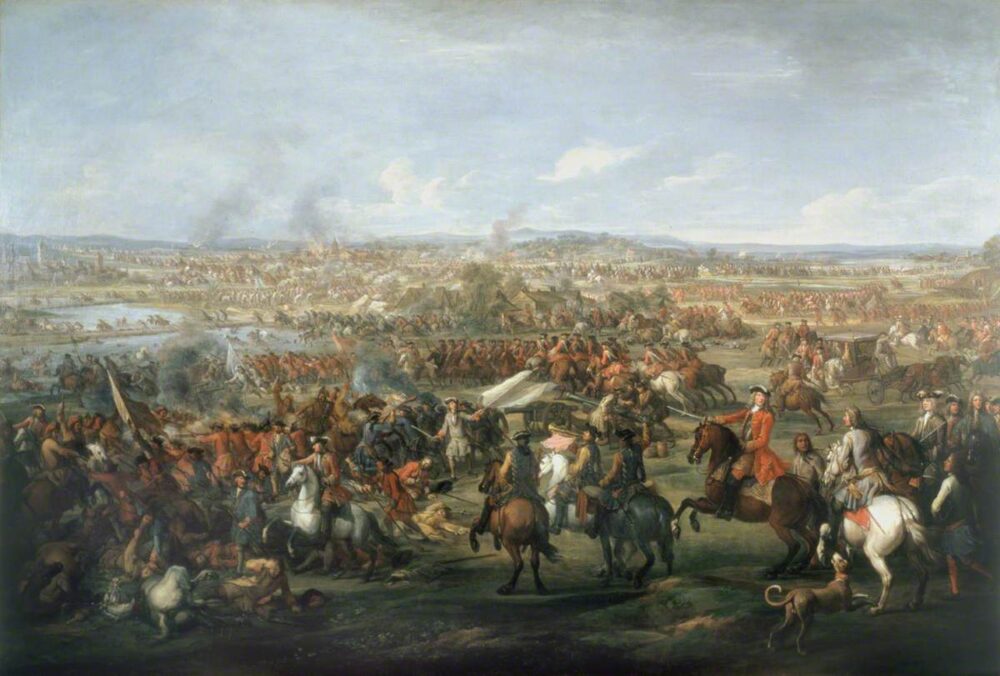
What happened
On August 13, 1704, the Duke of Marlborough and Prince Eugene of Savoy destroyed a Franco-Bavarian army on the Danube at Blindheim (anglicized as Blenheim) after Marlborough's army had marched some 250 miles from the Low Countries in a campaign of unprecedented speed and logistics. Marlborough pinned the French infantry packed into the riverside villages, then broke the weakened center with a massed cavalry attack; thousands of French troops were driven into the Danube or surrendered, including Marshal Tallard himself. It was the first major defeat of Louis XIV's armies in over forty years and saved Vienna, knocking Bavaria out of the war. A grateful Britain built Marlborough Blenheim Palace, where Winston Churchill would be born 170 years later.
Going Deeper
The battle is studied less for the fighting than for the march that preceded it, an operation that moved an army across the middle of a continent on pre-arranged supply contracts, with fresh shoes waiting at the halfway point, while allies and enemies alike were misled about where it was headed. Names betray whose history is being told: German writers call the day the second battle of Hochstadt, after the neighboring town, and the English name comes from an anglicized village. Marlborough's reputation has swung hard in both directions, savaged by Macaulay in the nineteenth century and rehabilitated at length in the twentieth by Winston Churchill, whose four-volume life of his own ancestor is read as much for what it reveals about the author as about the subject. The palace granted for the victory nearly ruined the family and became the center of a long quarrel with the Crown, a reminder that such rewards were political instruments rather than gifts.
Three new battles every day. Tap the globe where each one happened.
Play today's battles