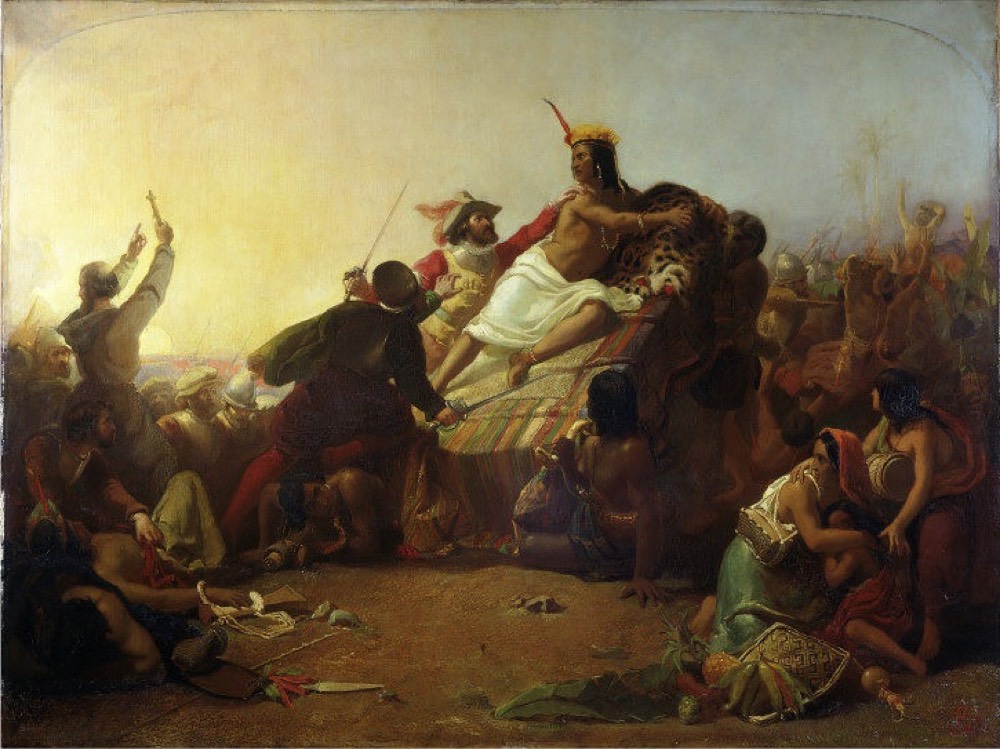
What happened
On November 16, 1532, fewer than two hundred Spaniards ambushed the ruler of an empire of millions in a mountain plaza and had him in chains before sunset. Atahualpa entered Cajamarca's square with a large but mostly ceremonial retinue, expecting an audience; when a friar presented him a breviary and he threw it down, Pizarro's men fired the guns and charged from the buildings around the square, and the crush in the enclosed space did much of the killing. Atahualpa offered a room filled once with gold and twice with silver for his release, and delivered it. He was executed the following year anyway. The empire he had just won a civil war to control was already carrying smallpox that had arrived ahead of any Spaniard.
Going Deeper
Every account of the ambush comes from the Spanish side or from Andean writers working generations later under Spanish rule, which means the most famous moment, the thrown book, survives only in versions written by people who needed the encounter to look like a justified response to sacrilege. The requerimiento, the legal formula read to Indigenous rulers to make conquest lawful, sits in the background of that scene and is now studied as a document of colonial legal theory rather than a description of events. Historians dispute how much weight to give steel and horses against the Inca civil war between Atahualpa and Huáscar, the epidemic that preceded the Spanish, and a diplomatic misreading that treated a small armed party as an embassy rather than a threat. Jared Diamond's use of Cajamarca as the set-piece of guns-germs-and-steel argument drew heavy pushback from Andeanists for compressing exactly those contingencies.
Three new battles every day. Tap the globe where each one happened.
Play today's battles