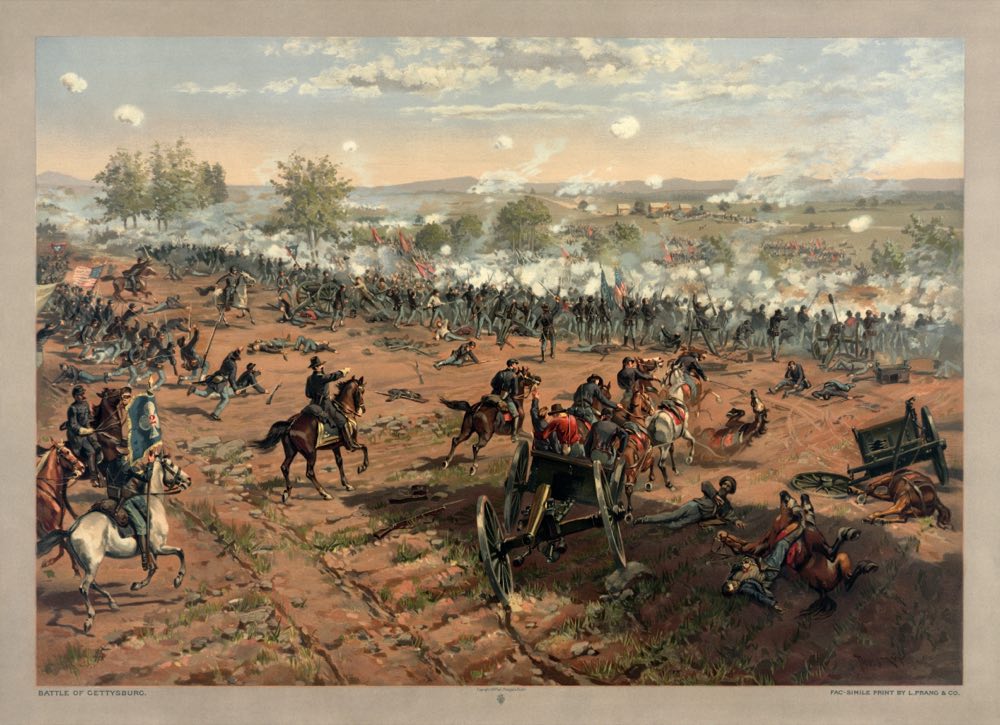
What happened
Robert E. Lee's second invasion of the North collided with the Union Army of the Potomac at a Pennsylvania crossroads town, producing one of the bloodiest battles of the American Civil War. Over three days in July 1863, roughly 51,000 soldiers were killed, wounded, captured, or missing across places whose names became American shorthand: Little Round Top, the Wheatfield, and Cemetery Ridge. The climax was Pickett's Charge, a failed Confederate assault across open ground against the Union center. Lee retreated to Virginia and never again mounted an invasion of the North on that scale. Four months later Lincoln used the battlefield's cemetery dedication to deliver the Gettysburg Address.
Going Deeper
Gettysburg's status as the war's 'turning point' is itself a historiographical battleground: the Confederacy fought on for almost two more years, and some historians give Vicksburg, which fell the next day, equal or greater strategic weight. The battle's memory was deliberately constructed - veterans' reunions, the Lost Cause literature that made Pickett's Charge a romantic high-water mark, and Lincoln's 272-word address that reframed the war's purpose entirely. Longstreet spent his postwar life blamed by Lost Cause writers for the defeat, a controversy modern scholarship has largely reversed in his favor. The battlefield itself became one of history's most intensely studied pieces of ground, with monument placement fights running well into the twentieth century.
Three new battles every day. Tap the globe where each one happened.
Play today's battles