What happened
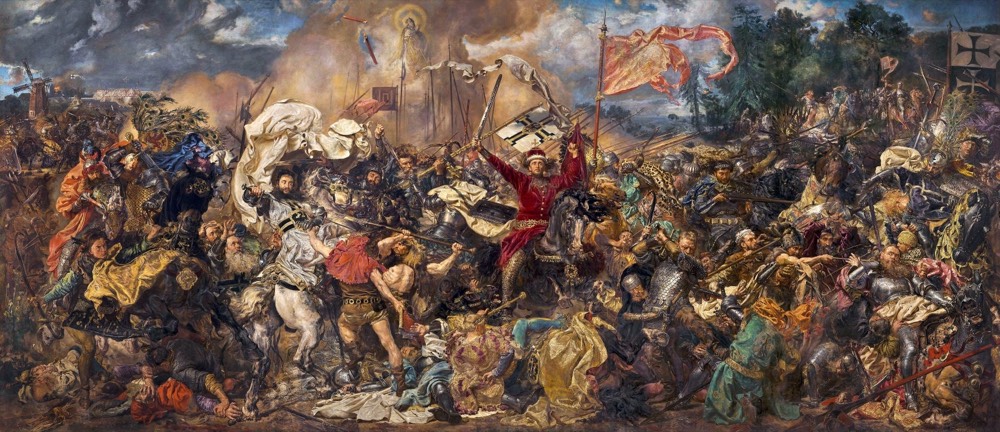
On July 15, 1410, the Teutonic Order lost its field army, its Grand Master, and most of its senior command in a single day's fighting between the villages of Grunwald and Stębark. The Order's heralds opened the day by presenting two bare swords to the Polish king and the Lithuanian grand duke as an invitation to fight; hours later the Lithuanian wing fell back, drawing part of the Teutonic line into a pursuit it could not reverse, and the Polish center enveloped what was left. Grand Master Ulrich von Jungingen was killed with hundreds of his knights. The Order's fortress at Marienburg held out through the siege that followed, so the war ended without dismembering it, but its aura of invincibility and its finances never recovered. The battle has three names, and which one a person uses says where they are from.
Going Deeper
Grunwald in Polish, Žalgiris in Lithuanian, Tannenberg in German: the naming is the historiography. In 1914 Hindenburg deliberately attached the name Tannenberg to a victory fought some thirty kilometers away, explicitly framing it as revenge for 1410, which is why two utterly different battles share a label. Under the partitions, Matejko's vast 1878 canvas made Grunwald the central image of a Poland that did not exist on the map, and the monument raised for the 500th anniversary in 1910 was destroyed by the Germans in 1939. Whether the Lithuanian withdrawal was a feigned retreat or a real rout that happened to work is argued from two nearly contemporary and incompatible accounts, Długosz and the anonymous Cronica conflictus, and the answer has always carried national stakes. Soviet-era historiography folded it into a Slavic and Baltic front against German aggression, and Žalgiris survives today as the name of Lithuania's most famous sports club.
Three new battles every day. Tap the globe where each one happened.
Play today's battles