What happened
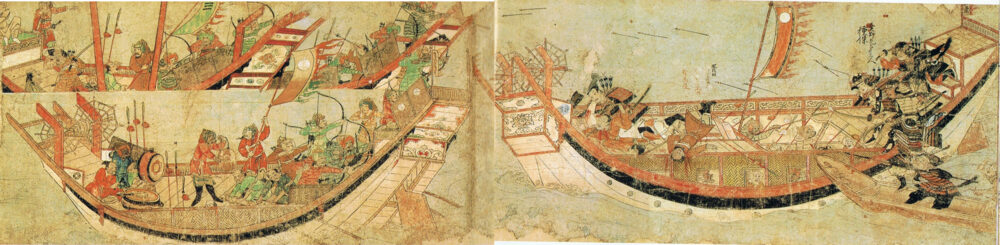
In the summer of 1281, Kublai Khan launched his second invasion of Japan, sending an enormous Mongol-Chinese-Korean armada against Kyushu. Japanese defenders fought the landings from behind a stone wall built along Hakata Bay after the first invasion in 1274, holding the invaders to the shoreline and harassing the fleet with night boarding raids. In mid-August a massive typhoon struck the crowded anchorages and destroyed much of the armada; survivors withdrew or were killed. The Japanese named the storm kamikaze ('divine wind'), a term that would be revived with different meaning in 1945. Chronicle figures for the fleet's size are likely exaggerated, but underwater archaeology at Takashima has confirmed the invasion's scale and its violent end.
Going Deeper
The richest Japanese source is a picture scroll commissioned in 1293 by a warrior named Takezaki Suenaga to press his claim for reward, which makes the classic visual record of the invasions a document about a compensation dispute. That dispute was arguably the deeper consequence, since a defensive war conquers no land: the shogunate came out victorious with nothing to distribute among thousands of warriors who had gone into debt to serve, and the grievance it could not settle features in standard explanations of the regime's collapse in 1333, alongside other strains. The shrines that had performed protective rituals during the invasions petitioned for their own share of the credit and the rewards, so the divine-wind reading was court politics before it was folklore. The recovered hulls have sharpened the picture of what was lost, pointing to a fleet assembled at speed, river craft among them, built by conscripted Korean and southern Chinese labor generally assumed to have had little reason to build well.
Three new battles every day. Tap the globe where each one happened.
Play today's battles