What happened
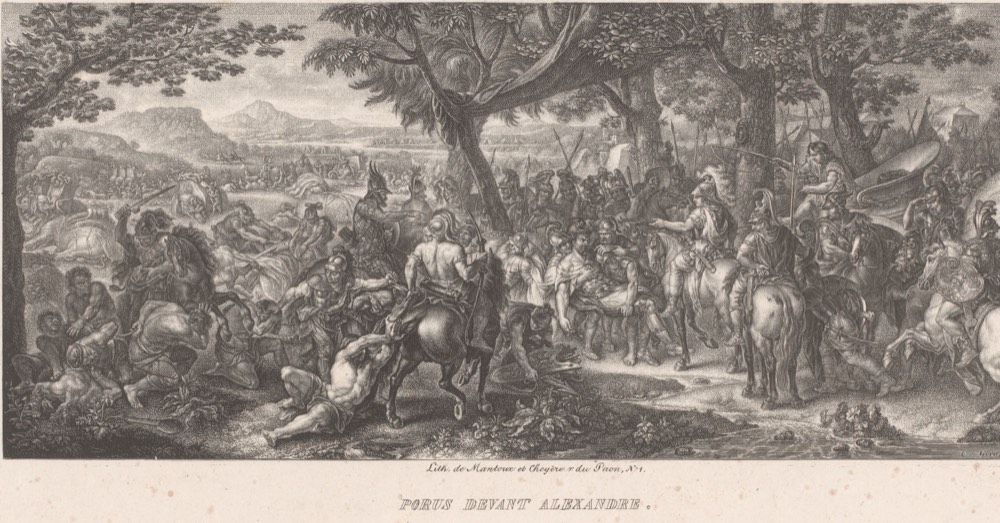
Alexander's last great battle was fought in a monsoon, across a flooded river, against an army built around two hundred war elephants. He spent weeks making noisy feints up and down the bank until Porus stopped reacting, then crossed at night in a thunderstorm several miles upstream and appeared on the same side as the Indian army at dawn. His cavalry pinned the elephants between his infantry until the animals turned on their own line. Porus, wounded and captured, is said to have asked to be treated as a king, and was left ruling his kingdom as Alexander's ally. Alexander's horse Bucephalus died soon after and a city was founded in his name; weeks later the army refused to march further east, and the conquest stopped at the next river.
Going Deeper
Nothing about this battle is recorded from the Indian side. The surviving narratives were written three to five centuries later by Greek and Roman authors working from lost campaign memoirs, and no Indian text names the battle or Porus, whose actual name and kingdom are reconstructed guesses. The site has never been found, partly because the Jhelum has shifted its channel repeatedly since antiquity, and rival identifications have been proposed since the nineteenth century without settlement. The casualty ratio in the sources, enormous on one side and trivial on the other, is exactly what court historians produce and is treated with suspicion. The exchange in which Porus asks to be treated as a king reads as a set-piece of Alexander literature, which has not stopped it becoming, in modern South Asian retellings, the moment the defeated king wins the moral argument.
Three new battles every day. Tap the globe where each one happened.
Play today's battles