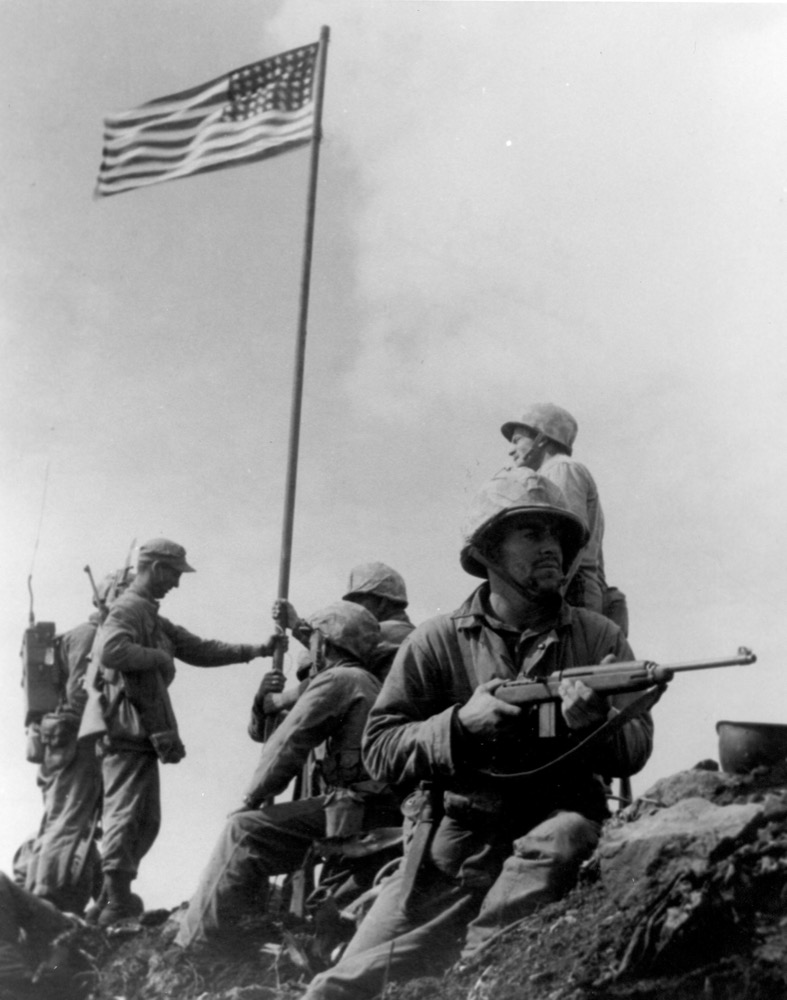
What happened
On February 19, 1945, U.S. Marines landed on Iwo Jima against a Japanese defense built around tunnels, caves, and mutually supporting positions. The famous flag-raising on Mount Suribachi occurred on the fifth day of the battle, but fighting continued for more than a month. The 36-day assault produced more than 26,000 American casualties, including about 6,800 dead, while nearly the entire Japanese garrison was killed. Twenty-seven Medals of Honor were awarded to Marines and sailors for the operation. Admiral Chester Nimitz's phrase, 'uncommon valor was a common virtue,' became inseparable from the battle.
Going Deeper
Iwo Jima's flag photograph became the most reproduced image of the war and an immediate object of controversy - the 'staged' accusation was false but durable, rooted in confusion between the first flag raising and the second, larger one Rosenthal shot. The Marine Corps itself twice corrected the identities of the six flag raisers, in 2016 and 2019, after amateur historians proved the official record wrong - a striking case of open-source scholarship overturning institutional memory. Strategists began questioning the island's cost against its value almost at once, a debate that continues: the emergency-landing justification was partly constructed after the fact. Japanese memory centers on General Kuribayashi's letters and the garrison that fought from tunnels to near-total annihilation; the island, returned to Japan in 1968, is still being searched for remains, with thousands of men from both sides unaccounted for.
Three new battles every day. Tap the globe where each one happened.
Play today's battles