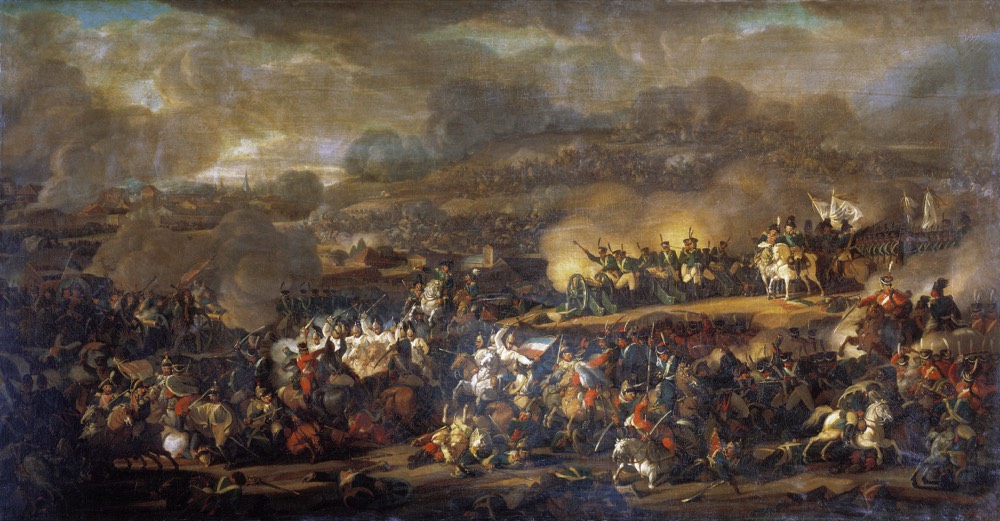
What happened
Over four days in October 1813, more than half a million men fought around Leipzig in what was, by most counts, the largest battle in Europe before the First World War. Napoleon held the ring for two days against converging Coalition armies, but Saxon and Württemberg troops changed sides during the fighting and the encirclement tightened until retreat was the only option. The withdrawal turned catastrophic when the single bridge over the Elster was blown early with thousands of troops still on the wrong bank; Marshal Poniatowski drowned trying to swim across. French power east of the Rhine collapsed within weeks, the Confederation of the Rhine dissolved, and the Coalition was over the French frontier by January. Germans have called it the Völkerschlacht, the Battle of the Nations, ever since.
Going Deeper
Leipzig became load-bearing for German nationalism long before Germany existed, and the enormous Völkerschlachtdenkmal raised for the 1913 centenary is the physical evidence: a monument to a battle in which Germans fought on both sides, dedicated a year before another war made the symbolism unusable. East Germany kept the monument and re-read it as a memorial to German-Russian brotherhood in arms, and it is now a preservation and interpretation problem rather than a shrine. Casualty totals remain estimates built from incomplete returns, and the Saxon defection is still argued over as either the hinge of the battle or a symptom of a decision already made. The premature destruction of the Elster bridge has its own literature about where responsibility lay, and Poniatowski's death gave Poland a martyr in a battle fought for the French.
Three new battles every day. Tap the globe where each one happened.
Play today's battles