What happened
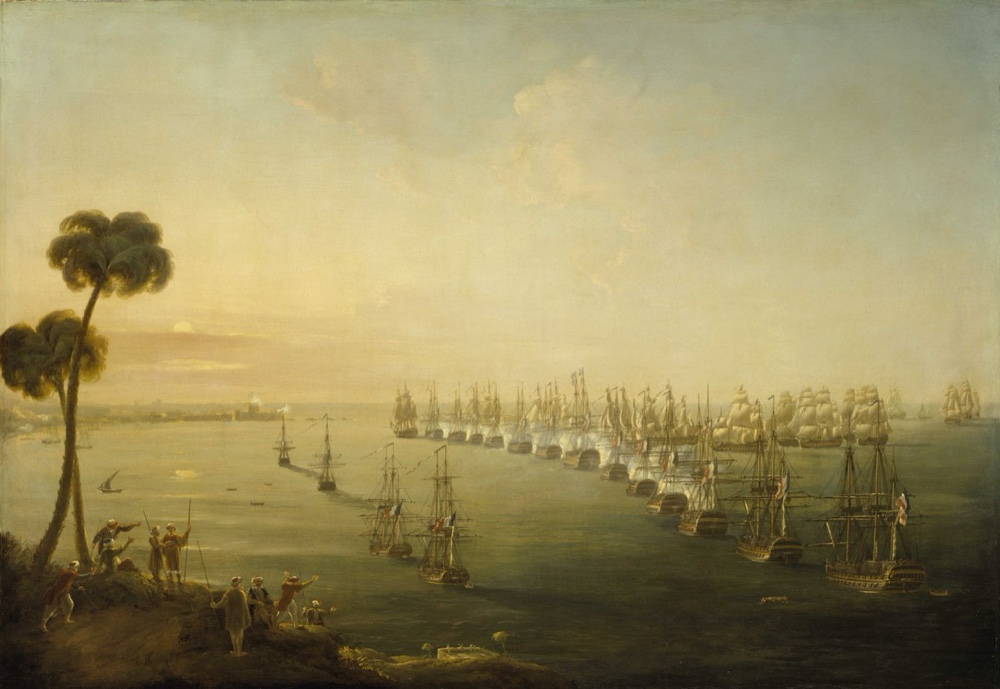
The battle called the Nile was fought in a bay about 20 kilometers from Alexandria and some 30 from the nearest mouth of the river, which has misled people for two centuries. Nelson found the French fleet anchored in a line close to shoal water and sent part of his squadron between the French ships and the shore, so that each French vessel was fought from both sides at once. At about ten at night the French flagship L'Orient blew up with a detonation heard in Alexandria, and the firing stopped for several minutes on both sides. Eleven of the thirteen French ships of the line were taken or destroyed. Bonaparte's army was left stranded in Egypt, and Britain's control of the Mediterranean was restored at a stroke.
Going Deeper
The destruction of L'Orient became one of the most painted events of the age and produced a poem, Casabianca, about the boy who stood on the burning deck, that generations of schoolchildren recited without knowing it described a real boy of about twelve, and which Elizabeth Bishop later took apart. Nelson's method has been argued over ever since: whether doubling the French line was a plan he had discussed with his captains in advance, as the band-of-brothers tradition holds, or an opportunity taken by a subordinate that the tradition later tidied into foresight. The wreck of L'Orient was located and first excavated in 1983 by Jacques Dumas, and the work was resumed in the later 1990s by Franck Goddio's team, which recovered ship remains along with parts of the treasure taken from Malta before the survey expanded across the drowned harbour landscape of Aboukir Bay. The battle also stranded the scholars Bonaparte had brought with him, whose enforced years in Egypt produced the Description de l'Egypte and, indirectly, the discipline of Egyptology.
Three new battles every day. Tap the globe where each one happened.
Play today's battles