What happened
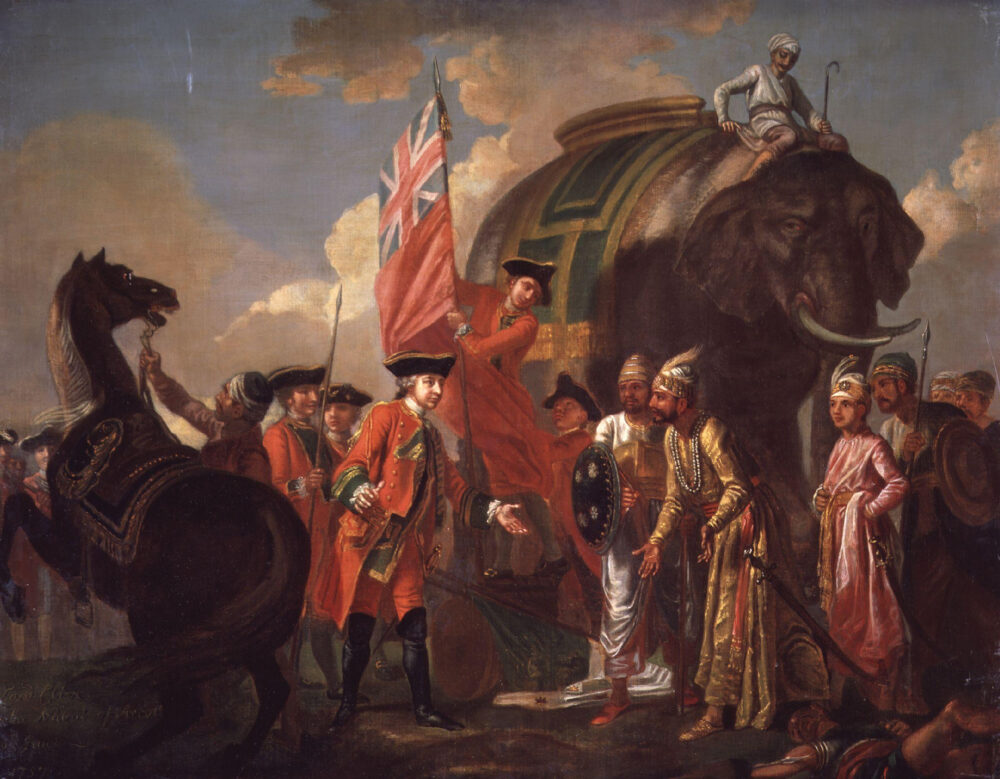
On June 23, 1757, Robert Clive's small East India Company army faced the vastly larger force of Siraj ud-Daulah, Nawab of Bengal, in a mango grove at Plassey. The battle was shaped as much by conspiracy as by combat: Mir Jafar and other commanders withheld large contingents, while a monsoon downpour disrupted the Nawab's artillery and the Company's ammunition was better protected. The Nawab's position collapsed; Siraj ud-Daulah was soon captured and killed by men aligned with the new regime, and Mir Jafar became nawab. Casualties were small for the stakes, but the political consequences were enormous. Plassey established Company military and political dominance in Bengal and opened the path to the revenue rights it formally obtained in 1765, a major foundation of later British rule in India.
Going Deeper
Whether to call Plassey a battle is a live question, since the decisive work was done by bankers and courtiers, above all the Jagat Seth banking house, and some historians present the day as a coup with a firefight attached. That reframing cuts both ways in Indian historiography, where nationalist accounts treat it as the beginning of subjugation while others insist on the agency of the Bengali elites who arranged and financed the outcome for reasons of their own. The argument with the longest reach is economic, over how much of Bengal's extracted revenue underwrote British industrialization, a thesis contested in its details rather than its outline since the nineteenth century. Clive returned to face a parliamentary inquiry into the fortune he had made, and the field itself has since been eaten into by the shifting channel of the river, leaving a modest monument on ground that is only approximately the place.
Three new battles every day. Tap the globe where each one happened.
Play today's battles