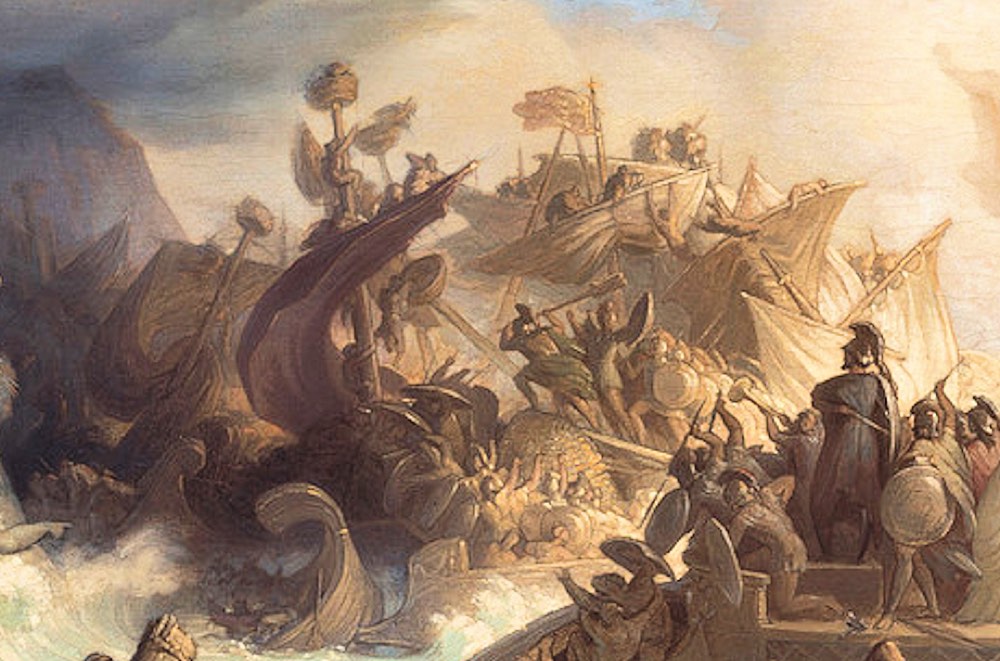
What happened
After Thermopylae and the evacuation of Athens, the Greek fleet confronted Xerxes' much larger navy in the narrow straits beside Salamis. Themistocles appears to have used deception to encourage the Persians to enter confined waters, where their numerical advantage was difficult to use. The Greek fleet won a decisive victory while Xerxes watched from the Attic shore. Ancient casualty and ship-loss figures vary widely. Xerxes soon withdrew much of his force to Asia, although major Persian land forces remained in Greece until their defeat at Plataea the following year. Salamis was a crucial turning point in the Persian invasion.
Going Deeper
Salamis rests almost entirely on Herodotus, writing decades later from Athenian informants with a stake in the outcome, and on Aeschylus's Persians, staged in Athens eight years afterward by a man who had fought in the wars, which makes the earliest surviving Greek tragedy also the earliest surviving account of the campaign. A single stone has generated its own literature: the Troezen inscription found in 1959, which appears to record the decree ordering Athens evacuated, is either a copy of a genuine document or a later reconstruction, and scholars have never agreed which. The larger argument is about meaning, since from the nineteenth century onward the battle was recruited into a story about a free West and a despotic East that ancient writers would not have recognized in those terms, and classicists now study that recruitment as closely as the fighting. The most durable domestic reading is quieter: the fleet was rowed by the poorest citizens, and ancient critics and modern historians alike have connected the widening of Athenian democracy to the men who pulled the oars.
Three new battles every day. Tap the globe where each one happened.
Play today's battles