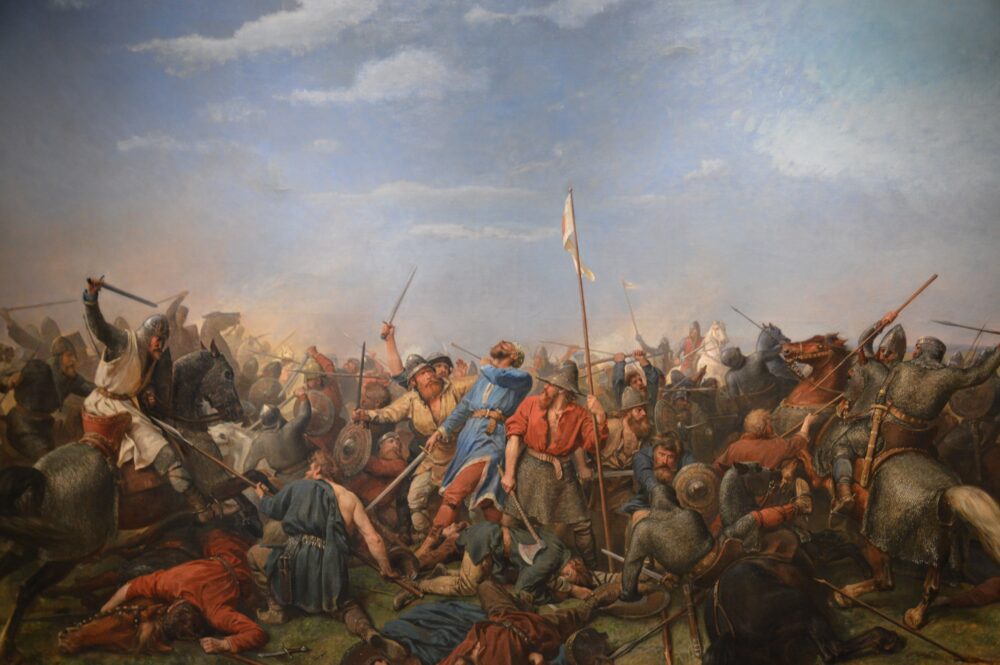
What happened
On September 25, 1066, King Harold Godwinson's English army surprised the Norwegian invasion force of Harald Hardrada at Stamford Bridge near York, after a forced march north of legendary speed. Caught on both banks of the Derwent without their mail, the Norwegians were destroyed; both Hardrada and Harold's exiled brother Tostig were killed. A later chronicle tradition tells of a lone Norwegian axeman holding the bridge until speared from beneath: vivid, but an embellishment added to the record generations afterward. The victory ended the Viking age's last great invasion of England, yet Harold had no time to savor it: three days later William of Normandy landed on the south coast, and within three weeks Harold was dead at Hastings.
Going Deeper
For a battle this famous, Stamford Bridge has left remarkably little on the ground: no confirmed weapon finds, no mass grave, and a crossing still argued from place-names and topography rather than excavation. Most of the drama comes from Snorri Sturluson, writing in Iceland a century and a half later, whose account borrows freely and may have transplanted details from other battles, while the near-contemporary English chronicles give the day only a few lines. Whether the march north and back cost Harold the crown three weeks later has been debated since the nineteenth century, with skeptics noting that the argument doubles as an excuse for a defeat English writers found hard to accept. The tidy notion that this day closed the Viking age is a later simplification, since Scandinavian raiding and Scandinavian claims to England both continued for decades.
Three new battles every day. Tap the globe where each one happened.
Play today's battles