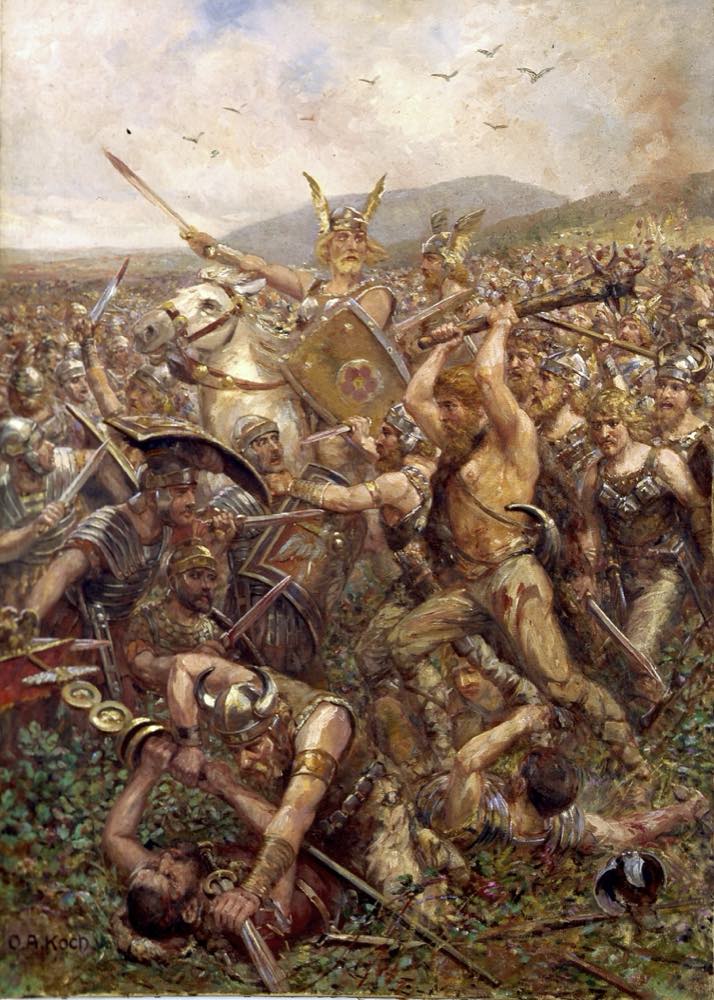
What happened
In AD 9, the Roman commander Publius Quinctilius Varus led three legions through northwestern Germania while Arminius, a Germanic leader who had served in the Roman military, secretly organized resistance. Over several days, Roman columns were attacked in difficult terrain and progressively destroyed. Varus died and the legion numbers XVII, XVIII, and XIX were never reissued. Rome later campaigned east of the Rhine under Germanicus, so it is too absolute to say it never again tried to project power there; nevertheless, the defeat helped end plans for permanent Roman provincial expansion deep into Germania.
Going Deeper
Teutoburg is archaeology's great battlefield vindication: the site at Kalkriese, identified in the late 1980s after a British officer's metal-detector finds, moved the battle from legend to landscape - coins, slingstones, the famous cavalry mask, and bone pits matching Tacitus's account of Germanicus burying the dead years later - though a minority of scholars still contest whether Kalkriese is the Varus battle or a later fight. The battle's modern career is the cautionary tale: nineteenth-century Germany built Hermann into a national founding hero, complete with the colossal Hermannsdenkmal (and a statue modeled after it in Minnesota), and the Nazis inflated the cult further, so postwar scholarship spent decades separating Arminius the Roman-trained auxiliary officer from Hermann the myth. Rome's response is its own debate - 'give me back my legions' aside, whether Augustus truly abandoned Germania or the frontier settled by choice remains argued.
Three new battles every day. Tap the globe where each one happened.
Play today's battles