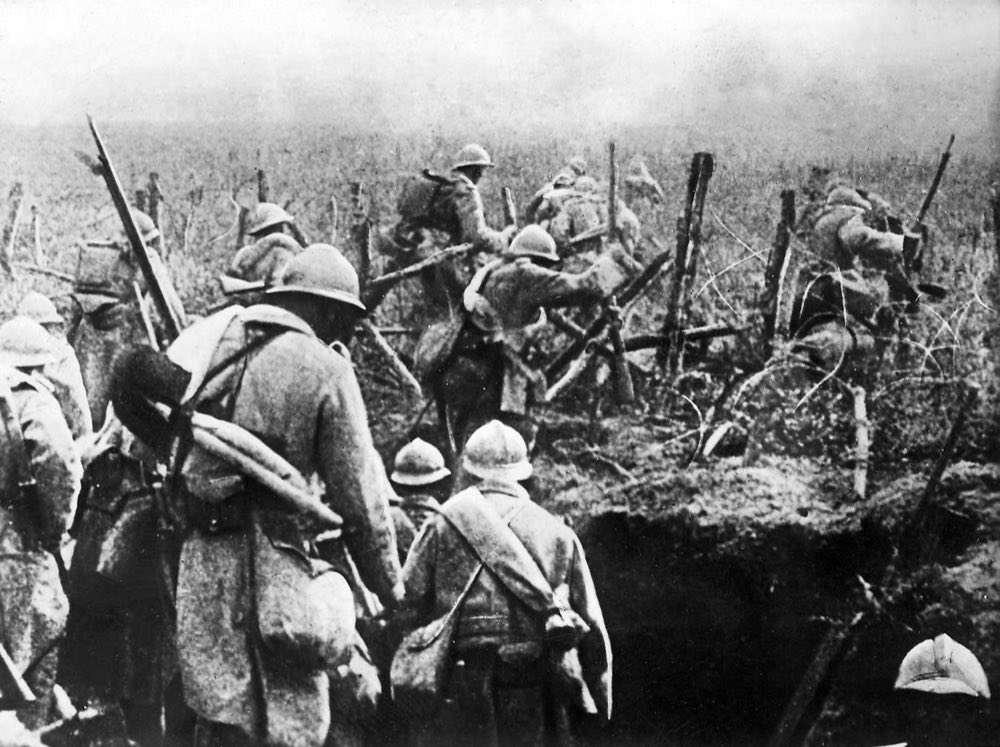
What happened
Germany opened the Battle of Verdun on February 21, 1916, attacking one of France's most symbolically important fortified regions. The battle continued until December and became one of the longest and deadliest struggles of the First World War, with roughly 700,000 combined casualties. Forts such as Douaumont and Vaux changed hands amid repeated offensives and counteroffensives. The French army rotated large numbers of units through the sector, making Verdun a national experience, while the phrase 'They shall not pass' became associated with its defense. The Douaumont Ossuary contains the remains of roughly 130,000 unidentified French and German soldiers.
Going Deeper
Verdun's status as France's sacred battle was built deliberately, and the awkwardness at its center is Petain: the officer whose stewardship in 1916 made him the battle's human symbol is the same man who signed the armistice of 1940, and France has never fully resolved what to do with that. German intent is the other long argument, since the claim that the offensive meant to bleed France white rather than take the city rests on Falkenhayn's postwar memoir, and many scholars suspect the rationale was constructed after the attack failed. Nine villages around the battlefield were destroyed, six of them so completely that they were never rebuilt, and those six retain a legal existence with prefect-appointed councils, while the ground still yields munitions and human remains every year. The site later became the chosen stage for Franco-German reconciliation, most famously when Mitterrand and Kohl stood hand in hand there in 1984, giving Verdun a meaning close to the opposite of the one it was assigned at the time.
Three new battles every day. Tap the globe where each one happened.
Play today's battles