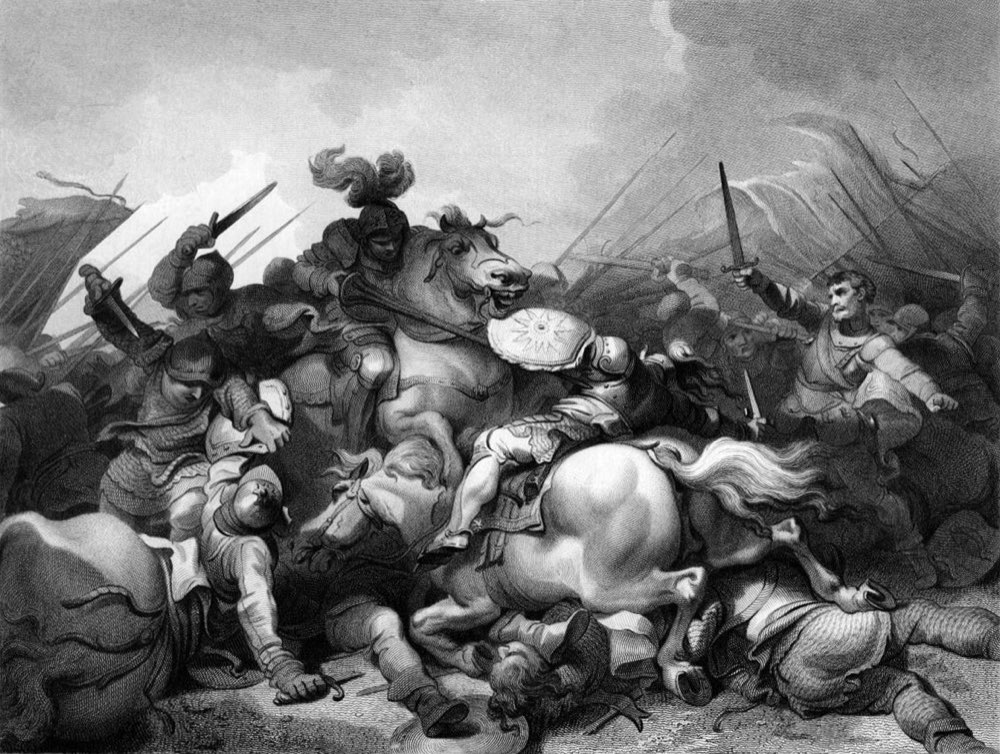
What happened
On August 22, 1485, Richard III became the last king of England to die in battle, cut down within yards of the rival he had charged across open ground to kill. Seeing Henry Tudor lightly guarded behind the fighting, Richard led a mounted charge that killed Henry's standard-bearer and came close to reaching him, at which point Sir William Stanley finally committed his uncommitted troops against the king. Richard's body was stripped and displayed in Leicester and buried without ceremony. The Tudor dynasty that began that afternoon lasted 118 years and wrote the history of the man it replaced. Both the battlefield and the king were lost for centuries and both were found again in the last twenty years.
Going Deeper
Two modern discoveries rewrote this battle. A survey completed around 2009 moved the site roughly two miles southwest of the traditional Ambion Hill after fieldwalking turned up the largest scatter of medieval round shot found on any European battlefield, along with a silver-gilt boar badge, Richard's own emblem, near the edge of a former marsh. Three years later a skeleton under a Leicester car park proved to be Richard himself, with severe scoliosis and battle wounds consistent with the sources, DNA-matched to living relatives, and reburied in 2015 after a court fight between Leicester and York over where he belonged. The find sharpened a long argument between the Shakespearean portrait, which descends from Tudor-era writers with obvious motives, and the revisionist case that has been pressed since the eighteenth century, without resolving the question at the center of it, which is what happened to Richard's nephews.
Three new battles every day. Tap the globe where each one happened.
Play today's battles