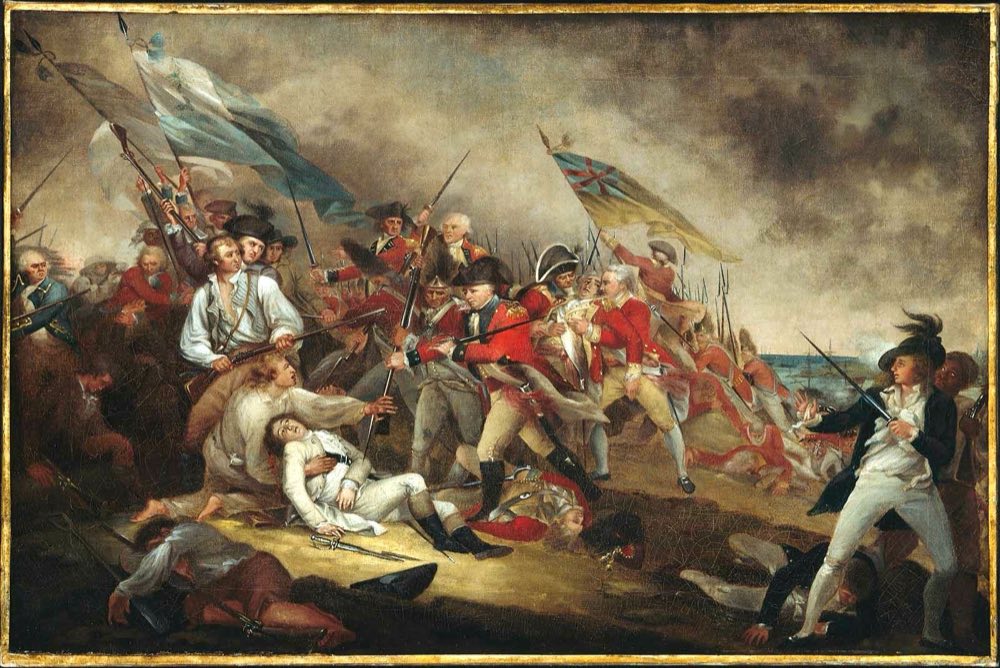
What happened
Two months after Lexington and Concord, New England militia fortified Breed's Hill overlooking Boston. On June 17, British regulars launched repeated frontal assaults and captured the position only after suffering more than 1,000 casualties. Colonial losses were roughly 450. Most of the fighting occurred on Breed's Hill even though the battle became known as Bunker Hill. The famous instruction to hold fire until the soldiers could 'see the whites of their eyes' is traditional and may not have been spoken exactly as later remembered. Although a British tactical victory, the unexpectedly high cost demonstrated that colonial forces could stand against regular troops.
Going Deeper
The battle produced one of the first American arguments about who owned a memory, with Boston antiquarians spending much of the nineteenth century disputing whether Prescott or Putnam had commanded, a quarrel that filled pamphlets and never resolved. The instruction about waiting for the whites of their eyes was attributed to several European officers before 1775 and belongs to the stock of military sayings rather than to any one man. Joseph Warren, killed on the hill and buried in a shallow grave, was identified months later by Paul Revere from a wired dental bridge Revere had made for him, which is usually cited as the earliest documented forensic dental identification in America. The monument raised on the site from 1825 and the oration Daniel Webster gave at its cornerstone helped invent the American habit of treating a battlefield as civic scripture.
Three new battles every day. Tap the globe where each one happened.
Play today's battles