What happened
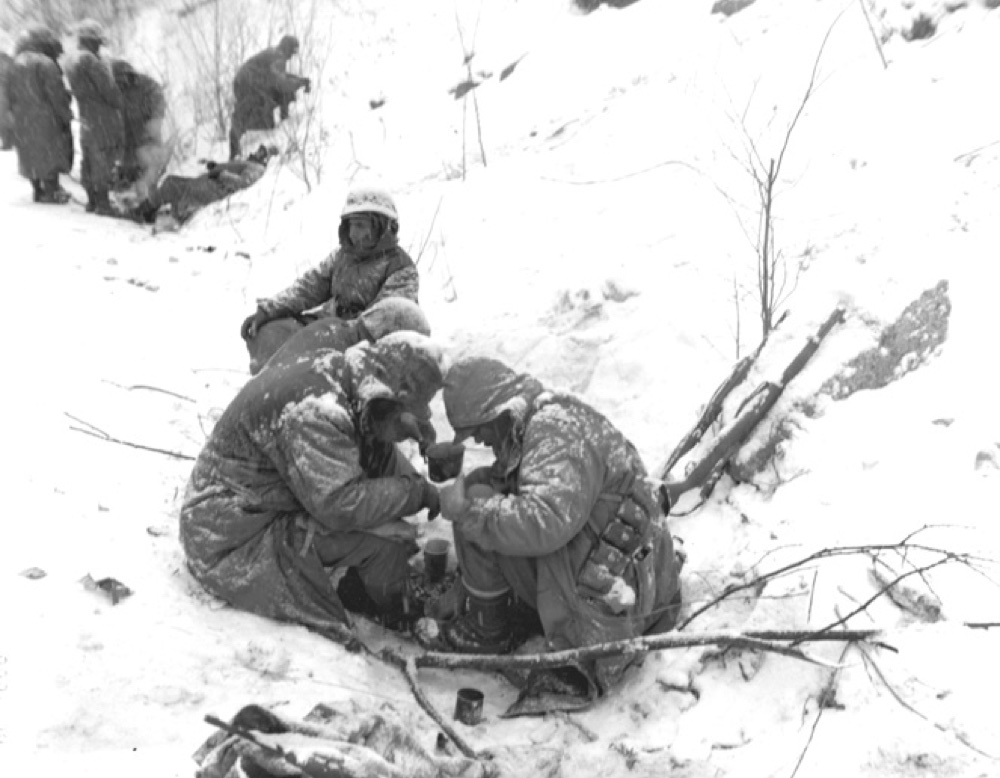
In late November 1950, Chinese forces struck U.N. units around the Chosin Reservoir in northeastern Korea, surrounding and dividing elements of X Corps in extreme winter conditions. Roughly 30,000 U.N. troops faced a much larger Chinese force, commonly estimated around 120,000 in the wider battle. The 1st Marine Division and attached units fought south toward the port of Hungnam while evacuating wounded personnel and much of their equipment. Maj. Gen. O.P. Smith's famous 'advancing in another direction' remark is widely associated with the withdrawal, though versions of the quote vary. The fighting at Chosin became one of the defining battles of Marine Corps history and enabled a large evacuation from Hungnam.
Going Deeper
The name on American maps is a Japanese reading of the Korean Changjin, so the battle is remembered in the United States under a label inherited from the colonial cartography of Korea. Its memory was kept largely by the men who were there, through a veterans' association that made the phrase Chosin Few a fixed term, at a time when the wider war was receiving little public attention in the United States. The evacuation from Hungnam that followed carried roughly a hundred thousand Korean civilians out with the troops, which is the part of the campaign best remembered in South Korea and least in America, and several of the families involved have written about it since. Chinese accounts of their own losses, enormous and largely inflicted by the cold, were not published for decades, which left the standard Western version of the battle without the other side in it for a long time.
Three new battles every day. Tap the globe where each one happened.
Play today's battles