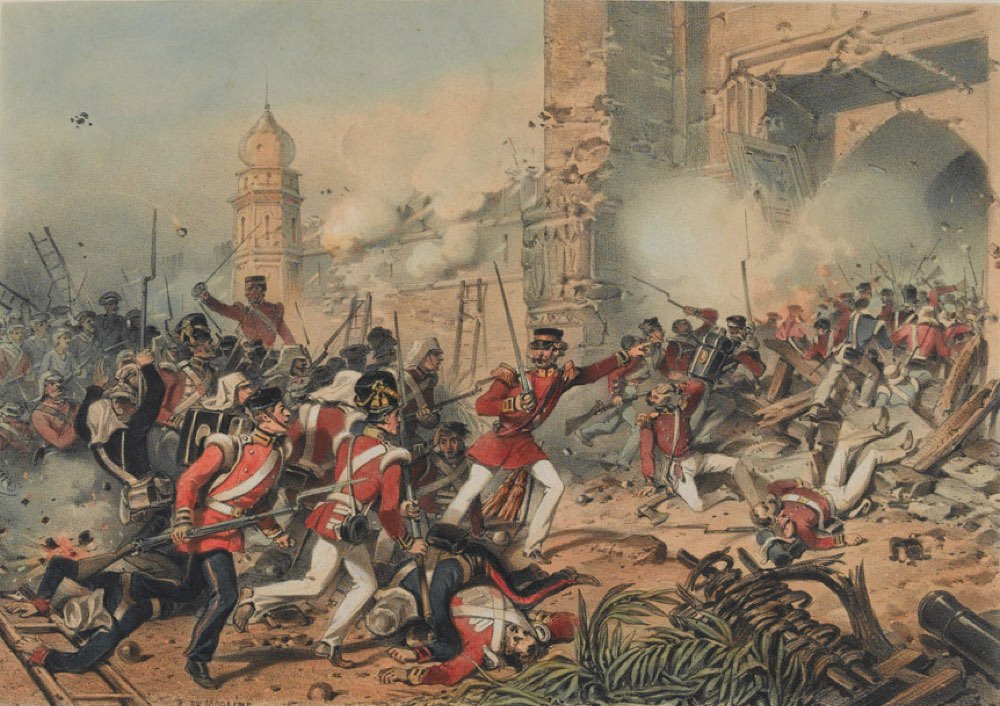
What happened
Sepoys who mutinied at Meerut in May 1857 rode to Delhi, killed the Europeans they found, and proclaimed the aging Mughal emperor Bahadur Shah Zafar their sovereign, which turned a military revolt into a claim on an empire. A small British force held a ridge north of the city through the summer, too weak to attack and unwilling to withdraw, until a siege train arrived and the walls were breached at the Kashmiri Gate on September 14. Six days of street fighting followed before the city fell. Zafar was captured at Humayun's tomb and exiled to Rangoon, and two of his sons and a grandson were shot by the officer who took their surrender. The dynasty that had ruled from Delhi for three centuries ended, and the East India Company's own rule ended with it, replaced the following year by the Crown.
Going Deeper
What to call 1857 has been contested for over a century, with mutiny, rebellion and first war of independence each carrying a position, the last popularized by Savarkar in 1909 and adopted by the Indian state. The city itself was the deeper casualty: much of Mughal Delhi was demolished after the recapture, the palace complex was gutted for barracks, and the population was expelled for months while prize agents worked through what remained. Historical work shifted substantially once the Mutiny Papers, thousands of Urdu and Persian documents produced by the rebel administration and left largely unread in the archives for a century and a half, were mined in the 2000s, which made it possible to write the siege from inside the city. The poet Ghalib lived through it and left an account in Dastanbuy that is read now as much for what he could not safely say as for what he wrote.
Three new battles every day. Tap the globe where each one happened.
Play today's battles