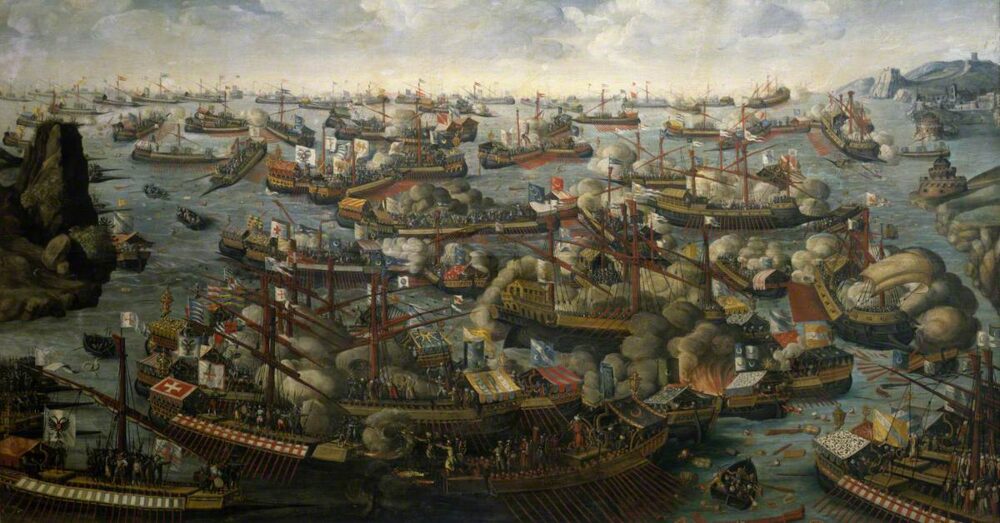
What happened
On October 7, 1571, the combined galley fleet of the Holy League (Spain, Venice, the Papacy, and allies) met the Ottoman navy at the mouth of the Gulf of Patras and destroyed it in one of the largest naval battles ever fought under oars. The League's heavy gunfire, including six towering Venetian galleasses stationed ahead of the line, broke up the Ottoman formations before the fleets ground together in boarding fights. Ottoman losses ran to most of their fleet and tens of thousands of men; thousands of Christian galley slaves were freed. The Ottomans rebuilt their navy with remarkable speed and kept Cyprus, so the war's territorial outcome was modest, but Lepanto ended the aura of Ottoman invincibility at sea. Cervantes, wounded in the battle, called it the greatest occasion past or present ages had seen.
Going Deeper
Historians have argued since Braudel over whether Lepanto changed anything, given that the Ottomans replaced the fleet within a year, kept Cyprus, took Tunis three years later, and watched the Holy League fall apart almost immediately. The celebration outran the strategy at once and has never stopped: the victory was painted by Titian and Veronese, folded into Catholic devotional life as a feast still kept on October 7, and versified by Chesterton in 1911 in a poem that carried the battle into twentieth-century politics, where European identitarian movements now invoke it routinely. The part the tradition omits is that both fleets moved on the backs of enslaved and convict rowers, and that the victors freed the Christians among them while the Muslims stayed chained. Ottoman writers treated the defeat as serious but recoverable, a reading modern scholarship largely endorses, which leaves Lepanto famous mostly for what people afterward decided it meant.
Three new battles every day. Tap the globe where each one happened.
Play today's battles