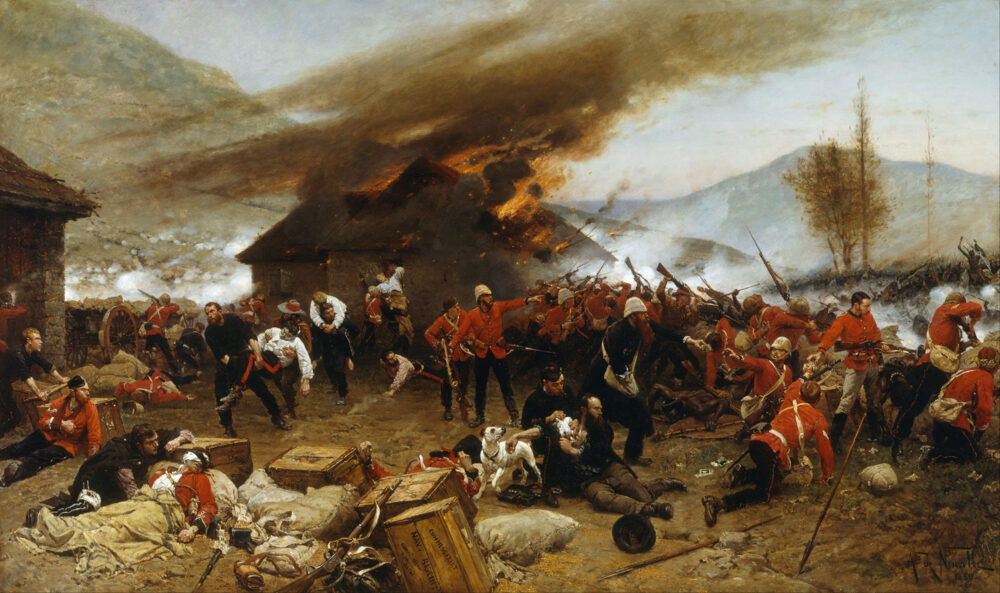
What happened
On the afternoon and night of January 22-23, 1879, hours after the Zulu army destroyed a British column at Isandlwana, roughly 150 British soldiers held the mission station at Rorke's Drift against some 3,000-4,000 Zulus. Warned barely in time, the garrison barricaded the post with mealie bags and biscuit boxes and fought at hand-to-hand range through the night, evacuating a burning hospital room by room. The attackers, reserve regiments who had missed the fight at Isandlwana and crossed into Natal against their king's orders, withdrew at dawn. Eleven Victoria Crosses were awarded for the defense, the most ever for a single action. The story became imperial legend almost instantly, and historians have long noted how usefully its heroism papered over the day's actual news, the catastrophe at Isandlwana.
Going Deeper
Rorke's Drift historiography is inseparable from its function: critics from the start (including Wolseley, who arrived as commander later that year) grumbled that the medal shower was politically convenient, converting the worst defeat of the Victorian army into a week remembered for heroism, and modern scholars broadly accept that framing while leaving the defenders' conduct itself intact. The 1964 film Zulu re-founded the legend for the twentieth century while inventing freely: the singing duel never happened, and Private Hook, portrayed as a malingering rogue, was by record a teetotal model soldier, a characterization his descendants have long objected to. Zulu perspectives, long absent, are now central to scholarship: the attack was unauthorized, tactically pointless after Isandlwana, and costly, and the wounded killed after the battle sit uncomfortably beside the VC narrative. The pairing with Isandlwana (catastrophe and redemption manufactured within the same 24 hours) makes the two battlefields, 15 km apart, a single lesson in how empires curate memory.
Three new battles every day. Tap the globe where each one happened.
Play today's battles