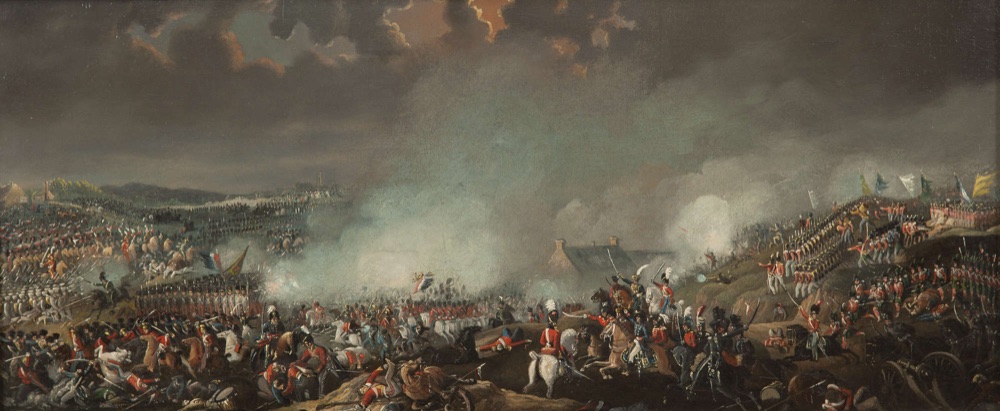
What happened
Napoleon's final battle decisively ended his Hundred Days and effectively closed more than two decades of French Revolutionary and Napoleonic warfare. His army hammered the Duke of Wellington's Anglo-allied line through the afternoon, but Wellington held the ridge until Bluecher's Prussians arrived in strength on the French flank. A final attack by the Imperial Guard failed and the French army collapsed. Napoleon abdicated four days later and was eventually exiled to Saint Helena. 'Meeting your Waterloo' entered the language as shorthand for a final, crushing defeat.
Going Deeper
Waterloo may be the most argued-over battle in European historiography, starting with who deserves credit: British accounts long centered Wellington's squares, while German historians pointed out that Blücher's Prussians arriving on the French flank decided the day. Victor Hugo's celebrated Les Misérables digression fixed the sunken lane and the doomed cavalry in popular memory, though historians treat his version as literature rather than evidence. Even the name is a choice: the French fought it as Mont-Saint-Jean, the Prussians called it La Belle Alliance, and Wellington's dispatch from the village of Waterloo named it for the anglophone world. Archaeology on the field has been surprisingly thin on human remains (only a couple of skeletons have ever been recovered), and recent scholarship argues a grim explanation: that battlefield bones were dug up in the decades after and sold, above all as bone char for sugar refining. It remains a documented hypothesis rather than proven fact, but it would explain the empty ground.
Three new battles every day. Tap the globe where each one happened.
Play today's battles